
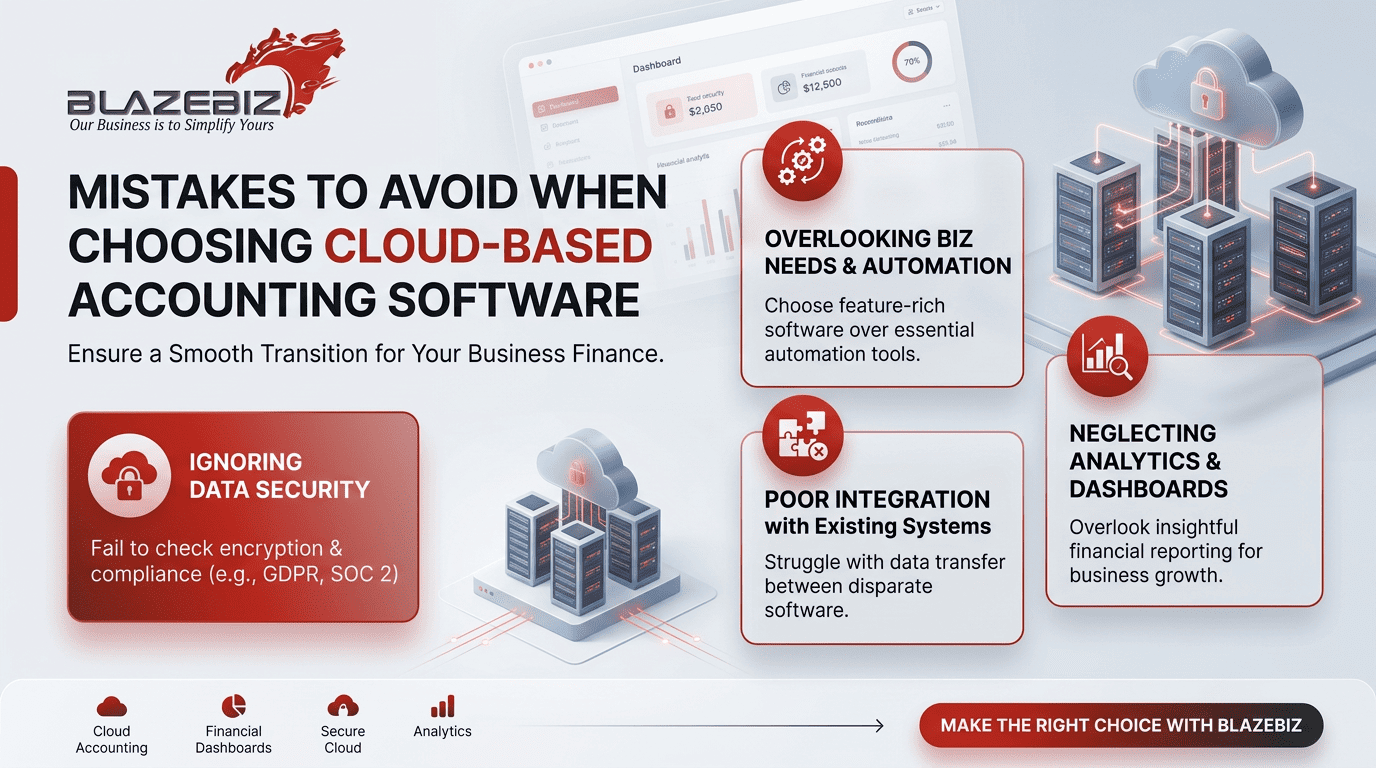
The choice of cloud accounting software is nowadays more than a mere IT decision; it is a strategic choice that impacts an organization's financial management compliance productivity, and long-term growth. For Malaysian companies that are looking to digital transformation and keep up with regulatory changes, the accounting system will also be a key thing in their day-to-day operating efficiency.
Many businesses make the mistake of looking only at price or other people's choices when evaluating software. Yet, a lower first price or a longer list of features do not necessarily mean more business value. A wrong choice can cause data migration problems, employee resistance, compliance difficulties and can even be a source of unexpected expenses that will harm the business.
Per BLAZE BIZ, choosing accounting software should take into consideration the business goals, operational requirements, and capacity for future growth rather than just marketing claims. This booklet is based on the typical errors that businesses make in the process of selecting their accounting software and shows the way to avoid them confidently.
Why Choosing the Right Accounting Software Matters in Malaysia
Malaysia’s business environment is becoming increasingly digital. From small businesses to established enterprises, organizations are expected to maintain accurate financial records, generate timely reports, and comply with local tax and e-Invoicing requirements.
An effective cloud based accounting software solution helps businesses:
- Improve financial accuracy
- Access real-time financial information
- Collaborate across departments
- Reduce manual bookkeeping
- Support business expansion
- Strengthen compliance with Malaysian regulations
When software aligns with business goals, it becomes a valuable asset rather than just another operational tool.
Mistake 1: Choosing Price Over Business Value
One of the biggest mistakes businesses make is selecting software solely because it is the cheapest option.
While cost is important, focusing only on subscription fees often ignores the total cost of ownership. Businesses may later discover hidden expenses for upgrades, integrations, additional users, customer support, or advanced reporting features.
Instead of asking,
“Which software costs the least?”
Ask,
“Which solution delivers the greatest long-term value?”
Consider factors such as:
- Automation capabilities
- Ease of use
- Customer support
- Data security
- Future scalability
- Integration options
- Regulatory compliance
A slightly higher investment today can save thousands of ringgit in operational costs over the coming years.
Mistake 2: Ignoring Malaysia’s Compliance Requirements
Accounting regulations continue to evolve, making compliance more important than ever.
Businesses should ensure that their accounting solution supports Malaysian business requirements instead of relying on generic international software.
Look for features that support:
- Malaysia e-Invoicing readiness
- Local tax requirements
- Financial reporting standards
- Audit documentation
- Accurate transaction records
Choosing cloud based accounting software that is designed with Malaysian businesses in mind reduces compliance risks and minimizes manual work.
Mistake 3: Buying Software That Cannot Grow With Your Business
Many businesses purchase software based only on their current size.
While this may seem practical initially, business needs change as organizations expand.
Imagine a company starting with:
- Five employees
- One office
- Basic bookkeeping
Within three years, it may have:
- Multiple branches
- Larger inventory
- Additional accountants
- Higher transaction volumes
- Multiple departments
If the accounting system cannot support this growth, businesses often face expensive migrations and operational disruptions.
A scalable solution should support:
- More users
- Additional business entities
- Multiple locations
- Higher transaction volumes
- Expanded reporting capabilities
Planning for future growth is far more cost-effective than replacing software later.
Mistake 4: Overlooking Ease of Use
Powerful software loses its value if employees struggle to use it.
Complicated interfaces often result in:
- Data entry errors
- Longer training periods
- Reduced productivity
- Poor employee adoption
- Inconsistent financial records
Decision-makers should evaluate software from the perspective of daily users rather than management alone.
Ask questions like:
- Can new employees learn it quickly?
- Are menus easy to navigate?
- Can reports be generated without technical expertise?
- Is the dashboard intuitive?
- Does it simplify everyday accounting tasks?
The best accounting software makes complex financial processes feel simple.
That is why BLAZE BIZ emphasizes user-friendly workflows that help businesses spend less time managing software and more time growing their operations.
Mistake 5: Ignoring Data Security and Backup Capabilities
Financial data is one of the most valuable assets a business owns. Yet, many organizations only ask about software features and pricing, forgetting to evaluate how their financial information will be protected.
A reliable cloud based accounting software solution should offer multiple layers of security to safeguard business data from cyber threats, accidental deletion, and unauthorized access.
When evaluating software, check whether it provides:
- Secure cloud infrastructure
- Data encryption during storage and transmission
- Role-based user permissions
- Multi-factor authentication (MFA)
- Automatic backups
- Disaster recovery mechanisms
- Activity logs for user actions
Security should never be treated as an optional feature. A single data breach or accidental loss of accounting records can disrupt operations, damage customer trust, and create compliance issues.
At BLAZE BIZ, security is considered a core business requirement because protecting financial information is just as important as managing it accurately.
Mistake 6: Choosing Software Without Integration Capabilities
Modern businesses rarely rely on a single application. Accounting systems often need to work alongside payroll, inventory management, CRM, banking platforms, and e-commerce systems.
Choosing software that operates in isolation creates unnecessary manual work and increases the risk of errors.
For example, imagine a retail company receiving hundreds of online orders every day. If employees manually transfer sales data into the accounting system, they may face:
- Duplicate entries
- Incorrect invoice amounts
- Inventory mismatches
- Delayed financial reports
- Increased administrative workload
Instead, businesses should look for software that integrates smoothly with other operational tools.
Mistake 7: Overlooking Customer Support and Vendor Expertise
Many businesses only evaluate software features and forget to assess the company behind the product.
Even the most advanced software may occasionally require technical assistance, user training, or implementation guidance.
Ask yourself:
- Does the vendor provide local support?
- How quickly are support requests answered?
- Are software updates released regularly?
- Is onboarding assistance available?
- Does the provider understand Malaysian accounting practices?
An experienced provider like BLAZE BIZ understands that accounting software is not a one-time purchase. Businesses need continuous support as regulations change, teams grow, and operational requirements evolve.
Mistake 8: Failing to Involve Your Finance Team
One common mistake made by business owners is selecting software without consulting the people who will use it every day.
Finance managers, accountants, and bookkeepers understand the practical challenges of daily accounting operations. Their feedback can help identify usability issues long before implementation.
Consider involving your finance team during:
- Product demonstrations
- Trial periods
- Feature evaluations
- Reporting assessments
- Workflow discussions
This collaborative approach often leads to better software adoption and fewer implementation challenges.
Mistake 9: Not Planning the Implementation Process
Buying software is only the beginning.
Without a structured implementation plan, businesses often experience delays, employee frustration, and inaccurate financial records.
Successful implementation requires careful preparation.
A Simple Implementation Roadmap
| Stage | Recommended Action | Business Benefit |
|---|---|---|
| Business Assessment | Define accounting requirements | Clear software objectives |
| Data Preparation | Clean and verify financial records | Accurate migration |
| User Training | Train finance and operational teams | Faster adoption |
| System Testing | Validate reports and workflows | Fewer operational errors |
| Go-Live | Launch with technical support | Smooth transition |
| Continuous Review | Monitor performance and optimize | Long-term efficiency |
A phased implementation minimizes disruptions and helps employees adapt more comfortably.
Mistake 10: Focusing Only on Today’s Needs
Business technology should support future growth, not just current operations.
Many companies purchase software that satisfies today’s requirements but lacks flexibility for tomorrow’s challenges.
Ask questions like:
- Will this software support multiple branches?
- Can it handle increasing transaction volumes?
- Will additional users be easy to add?
- Can new business entities be managed?
- Does it support future automation?
Choosing cloud based accounting software with long-term scalability protects your investment and eliminates the need for costly system replacements in the future.
Frequently Asked Questions
⬇
1. Why is cloud based accounting software becoming popular in Malaysia?
Businesses are increasingly adopting cloud solutions because they provide real-time financial access, improved collaboration, automated processes, stronger security, and better support for Malaysia’s digital business environment and e-Invoicing initiatives.
2. How do I choose the right cloud based accounting software for my business?
Start by evaluating your business size, industry requirements, expected growth, compliance needs, integration capabilities, ease of use, security standards, customer support, and overall long-term value rather than focusing only on cost.
3. Is cloud accounting software secure for storing financial data?
Yes. Reputable providers use encrypted data storage, secure cloud infrastructure, user access controls, multi-factor authentication, automatic backups, and disaster recovery systems to protect sensitive financial information.
Conclusion
Deciding to go for the right cloud-based accounting software is a major decision as it will impact your business's financial efficiency, compliance, and its growth for the future. Although low prices and feature-rich software may be very tempting, the most suitable solution is the one that is in line with your business objectives, meets Malaysian statutory requirements, complements your current systems, and is capable of growing with your business.
Using BLAZE BIZ, Malaysian companies do not just get accounting software; they get a reliable technological partner who is dedicated to making financial management easier through smart automation, the use of a secure cloud environment, and compliance-ready solutions. No matter whether you are a startup, SME, or a growing enterprise, making the right accounting platform decision at present will enable you to have a stronger and more resilient business in the future.